




Sign up for daily news updates from CleanTechnica on email. Or follow us on Google News!
March’s auto sales saw plugin EVs at 60.7% share in Sweden, up year-on-year from 58.1%. BEV share was flat YoY, while PHEV share was slightly up. Overall auto volume was 24,204 units, fractionally up YoY. The Volvo XC40 was the best selling BEV.
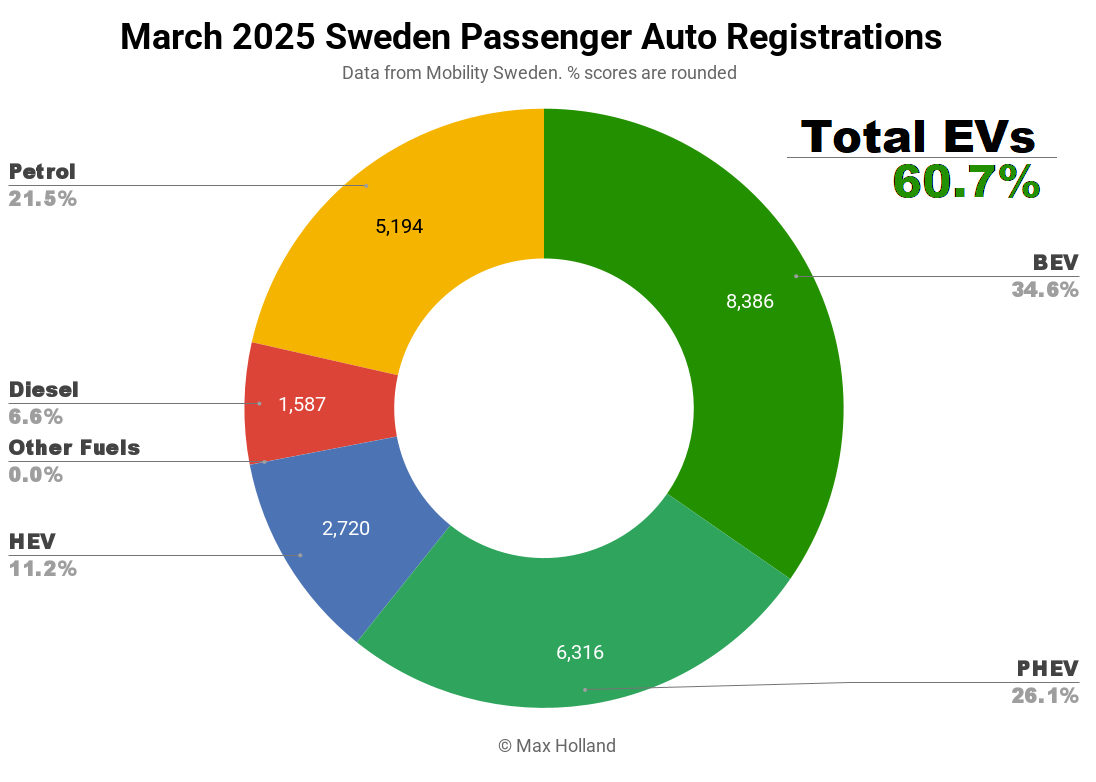
March’s sales totals showed combined plugin EVs at 60.7% share in Sweden, with full electrics (BEVs) at 34.6% and plugin hybrids (PHEVs) at 26.1%. These figures compare YoY against 58.1% combined, 34.9% BEV and 23.2% PHEV.
The first quarter of 2025 has only seen moderate progress in the EV transition, with February showing noticeable YoY growth, whilst January and March — taken together — were barely changed. The year-to-date plugin share now stands at 58.0%, from 54.5% at this point in 2024. The BEV share of the market has increased from 30.9% to 33.0% YoY, thus grabbing an additional 2% of the market pie — a rate of change which would require another 33 years to get to 100% BEVs.
January saw the anomalous pull forward of last-chance “Ethanol Vehicle” sales to over 5x their normal volumes, however, which artificially dampened plugin share. That ethanol category is now defunct, having only averaged 2 monthly units since. Without such anomalies, EV progress would perhaps be a little better than the figures suggest.
On the other hand, whilst there is a continuing erosion of combustion-only vehicle sales, at the moment the gap left over is being filled by both plugless hybrids (HEVs) and by plugins, with HEVs performing more strongly, at least in relative terms. Coming from a lower base volume, HEVs are up in volume by 38% year to date, whereas combined plugins are up a little under 13%, against the overall market being up 6.1%.
We know that the EV transition is still mostly only being driven by regulatory sticks in the overall European market. The region’s legacy auto makers (recently caught in a cartel scheme along with their lobbying organisations) are not on board with transitioning to electric (unlike in China). Their profits come from rent-seeking (and barriers to entry) from their past ICE investments. The nexus of industry and politicians also appears (to me at least) to be colluding to keep out genuine competition.
In January’s report I had said that the then-operative 2025 emissions regulations should result in progress this year, but that the boost in share would perhaps be mainly visible only towards the end of year as the full year deadline approached.
We now know that EU regulators have again caved to legacy auto pressure to protect profits, and have proposed watering down the emission rules, by folding 2025’s targets into a less urgent “net progress by the end of 2027” requirement instead. Note that this is only possible with the tariffs on genuinely competitive BEVs coming from outside Europe.

Best Selling BEVs
The Volvo XC40 led the BEV sales ranking for the second consecutive month, scoring 814 sales in March. In second spot was the Tesla Model Y, with 771 units, and the Volkswagen ID.7 came third with 644 units.

Volkswagen Group had a strong showing with six of the top ten, plus two Audi models in 17th and 18th. Geely (with Volvo, Polestar and Zeekr) also did well, with six models in the top twenty.
The Kia EV3 dropped a few spots from its third place in February, though likely only due to temporary logistics arrangements.
One of those Audis mentioned above was the new A6 e-tron, which hit a personal best 150 units, and its first appearance in the top 20, having only started proper customer deliveries in January.
One debutant in March was a new model from Zeekr, the 7X, which saw an initial 10 units registered. This new model joins Zeekr’s existing X and 001 models in the Swedish market. The new Zeekr 7X is a premium mid-large (4,787 mm) SUV coupe, which has an MSRP starting from SEK 579,000 (€54,100).
One of its key features is extremely fast DC charging, able to recharge from 10% to 80% in just 13 minutes in optimal conditions. That’s as fast as most mid-roadtrip quick breaks in an ICE vehicle. Let’s see how the new 7X gets on. Its sibling the Zeekr X has paved the way for the brand, typically ranking a respectable 20-something over the past 6 months.
In terms of other recent new BEV models, there’s no notable volumes yet for the new Skoda Elroq, nor for the Citroen e-C3. The new Renault 5 has likewise not properly launched customer deliveries yet, with just a handful of (presumably showroom) units delivered over the past three months. It’s a similar story also for the Hyundai Inster, which saw 37 units in February, but only to break the ice, and hasn’t yet been given a regular volume shipment pattern.
Let’s now turn to the 3-month rankings:

With the past two months in pole position, it’s no surprise to see the Volvo XC40 take the top spot for the quarter, with 1,771 units. The Volkswagen ID.7 has consistently been in the top 5 over the past 6 months, and in the top 3 for the past 4 months, so grabbed second place in the chart. The Tesla Model Y takes 3rd spot.
The newish Kia EV3, despite being at a low ebb in March, is still improving overall and has grabbed 6th spot in Q1. Depending on its logistics stability, it could still climb higher from here.
The new Audi A6 e-tron is also a strong climber, and after just 3 months of significant volume, has gained 28th spot. If April sees similar volumes to March, we will see the Audi enter just inside the top 20.
As I mentioned last month, I’ll be interested to see — over the medium term — how the new small cars like the Hyundai Inster, Citroen e-C3, and Renault 5 get on in Sweden. Perhaps they will arrive in greater volume in the summer when local conditions are more favourable.
Outlook
The year-on-year stability in overall auto market volume is in keeping with the broader Swedish economy. Latest GDP data showed 2024 Q4 back to 2.4% YoY growth, in keeping with Sweden’s long-term norms. Inflation reduced further to 0.5% in March, and interest rates remained flat at 2.25%. Manufacturing PMI in March was 53.6 points, effectively flat from February, and indeed fairly stable over the past 6 months.
As we’ve learned-by-frustration over the past decade, Europe’s overall BEV transition is not happening organically, as many other historical technology transitions (or adoptions) have done. Why not? How come the EV transition is happening at a normal or “expected” speed in China, but not in Europe?
The difference, in my view, is twofold (at least). Firstly, in Europe (and several other regions) the auto industry is bigger and more entrenched than most, not dissimilar to the energy industry, with century old super-giant vested interests who are profiting from the status quo. Like the energy industry, the auto industry also has super-giant, deeply entrenched, vested interests, also profiting handsomely from the status quo.
It is almost impossible for outside innovation to enter this entrenched legacy auto industry, due to the complexity of the end-products, complexity of supply chains, complexity of vehicle safety regulations and multi-jurisdictional legal compliance (making the end products ever more complex), the sheer amount of capital investment needed to get to commercial scale, etc. The auto industry in Europe is a textbook case of ”barriers to entry”. Added to that, existing players collude together (and via lobbying organisations like the ACEA and SMMT) to protect their status quo and to avoid bothersome changes that may threaten their profits.
As for the wider question of how things have been allowed to become this skewed and dysfunctional in Europe, whilst China escapes this trap, this brings me to my second point, and it’s also related to the relative strength of vested interests in two different political economic systems.
Political corruption — funded by vested interests (i.e. the capitalist class) — under neoliberalism (the current face of the capitalist political economy) has become somewhat normalised in European societies (amongst others). The fact that many politicians (whilst supposedly serving the common people) in neoliberal societies mysteriously become abnormally rich, doesn’t even raise an eyebrow in the media and chattering classes in these societies.
Capitalist interests, such as legacy energy, and legacy auto (and their owners and courtiers), are obviously not keen to see disruptive change. These kinds of interests all too often “work with” the political class to keep any inevitable technological changes as slow and un-disruptive (to profits and vested interests) as possible. In short, regulatory capture.
How is it that China’s EV transition has happened at a pace more typical of technological transitions (or “technology adoption curves”)? China has a very different political economy which follows a totally different philosophy. Put simply: China has a policy of weeding-out and severely punishing and shaming corrupt politicians, and – by this and other measures – actively prioritises preventing regulatory capture by capitalist interests. China is a socialism-first political economy, which is designed to keep the influence of capitalist interests on a tight rein. The political economy does allow some degree of capital interests to contribute to market dynamics and to innovation, but does not allow capitalist interests to accumulate overweight political power and influence, nor to control high-level social goals (e.g. poverty reduction), nor to control the overall political economy.
Nor does socialism-with-Chinese-characteristics allow capital interests to become over-entrenched to the level of becoming long-term status quo vested interests, which develop their own socio-political mechanisms (e.g. owning mass media) to obfuscate and control the narrative, (including of course, diverting popular attention from that very same entrenched influence of capital interests), and to block change and innovation, and to become permanently embedded in the political economy.
The idea of market / capital interests existing only as a subset within the broader societal context is taken seriously in China, whilst this idea is merely given lip service (e.g. by ESG and CSR rituals) in neo-liberal capitalist economies. In a former existence, I pioneered CSR and ESG courses in university MBA programmes (and taught them to hundreds of students), as well as interacting with the ESG practitioners inside large corporations, so I speak from some experience.
All this is to say that – until EVs gain unstoppable momentum (and preference) in the eyes of consumers – the EV transition in Europe will only go at the speed that legacy auto (and their adjacent politicians) want it to. The recent EU Commission plan to further slow down the regulatory requirements should no longer be a surprise, and likely won’t be the last example of delay. It’s simply a classic example of regulatory capture. In the US, it seems to me (from the outside) that these problems are of a similar nature, but often even more pronounced, though please weigh in if you have a detailed critical understanding of the issues.
On a more optimistic note, I do have a hope that these new, somewhat affordable BEVs (e-C3, Inster, etc) – themselves long-overdue in Europe – might help build towards the eventual tipping point of consumer-led momentum, and insistence on a speedy transition to the new technology. Eventually this will happen, but the question is, how long before we reach that point in Europe as a whole? A few years ago we assumed Norway’s early and fairly rapid transition (albeit a fairly normal speed in the history of technology adoption, and now repeated in China) would be mirrored by Europe as a whole, but we now know that’s not happening.
But what are your thoughts about the EV transition in Sweden, and Europe more broadly? Feel free to disagree with my perspective, or my (necessarily succinct) political economy analysis, in the comments. Please join in the conversation and discussion.
Whether you have solar power or not, please complete our latest solar power survey.
Chip in a few dollars a month to help support independent cleantech coverage that helps to accelerate the cleantech revolution!
Have a tip for CleanTechnica? Want to advertise? Want to suggest a guest for our CleanTech Talk podcast? Contact us here.
Sign up for our daily newsletter for 15 new cleantech stories a day. Or sign up for our weekly one if daily is too frequent.
Advertisement
CleanTechnica uses affiliate links. See our policy here.
CleanTechnica’s Comment Policy